

Strength Conditioning Program Design
04 Sep 2017
How to Create a Strength Training Program For Young Athletes . The bottom line is that you need to develop a well- rounded, comprehensive program that encourages hard work and progressive overload of the musculature. If those components are in place, you are well on your way to helping your athletes reap the benefits of a strength training program for young athletes.


Strength Training for Young Athletes Component #1: Comprehensive. A strength training program for young athletes should address every major muscle group in the body: chest, upper back, shoulders, biceps, triceps, neck (for collision sports), abdominals, lower back, hips & glutes, quadriceps, hamstrings and calves. Certain sports will focus more on a particular body part or require specialized work on smaller muscle groups (i. In general, an equal amount of work should be done on each side of a joint. A strength training program for young athletes should address every major muscle group in the body. Deficiencies can be overcome through a strength training program, but it generally takes specialized assessment to determine which muscles are deficient.
Strength Training for Young Athletes Component #2: Progressive. In order for any program to be effective, there must be a systematic and progressive overload of the musculature. In other words, athletes should systematically attempt to perform more work on a given exercise. For example, an athlete who can perform a maximum of 1.

When 1. 1 can be performed, 1. Progress can be made through any of the following: increasing the number of repetitions, increasing the amount of weight, increasing the number of sets, increasing the number of training days per week, decreasing the amount of rest time between sets, or a combination of any of these.
One of the easiest approaches is called “double progression”. To use this method, start by determining a range of repetitions you are going to use, for example 6- 1. If the athlete is unable to perform at least 6 reps, the weight is too heavy. If more than 1. 0 reps can be performed, the weight is too light. During each workout, one more rep should be attempted until the top of the range (1. When the top of the range is achieved, the weight will be increased at the next workout by the smallest amount possible.
Strength Training for Young Athletes Component #3: How many sets? The number of sets used on an exercise or within a complete workout can vary greatly, but the following guidelines can be used. In most cases, 1- 3 sets will be performed for each exercise and 1. If fewer sets are used, each set should be performed with maximum intensity. In other words, the set should be taken to the point of momentary muscular fatigue, or no more reps can be performed. If the athletes are unable to perform with maximal intensity, it is generally a good idea to complete multiple sets of an exercise.
Strength Training for Young Athletes Component #4: How many reps? While there is great debate of the number of repetitions that should be used in a set, it really should not be confusing. In general, it is recommended that 6- 2. While this is a large range, it offers a guideline in which to create smaller rep ranges from.
A snapshot of Justin Keogh's presentation 'Gluteal and posterior chain exercises - Applications to athletic performance and injury prevention' - 2014 ASCA International Conference on Applied Strength and Conditioning. Robert dos Remedios, Coach Dos, created a step-by-step training system for designing strength & conditioning workout programs called Complete Program Design. Strength & Conditioning Training for Netball 1. STRENGTH & CONDITIONING TRAINING for netball<br />Jon Renes<br /> 2. Overview<br />The “S’s” of sport<br />HP model<br />Benchmarking<br.
It is best to choose ranges of 4- 6 reps, such as 6- 1. As long as your program continually challenges the athlete to perform a greater amount of work, strength gains will be made. Any rep range will work. There are, however, some subtle differences between the benefits of each rep range. Lower rep ranges (i. Very heavy weight (relative to the athlete’s strength) must be used which can be potentially dangerous because athlete may have a tendency to use improper technique to lift the weight.
- Softball Conditioning - Get a personalized softball training program to increase your hitting power, throwing velocity, speed, agility, and quickness.
- Strength Training Program For Young Athletes. IYCA Expert Jim Kielbaso shares how to create an effective strength program, offering up his successful system.
- Curious about what exercise program to follow? How to stay motivated and accountable? We can help with that. Hi, we’re South Loop Strength & Conditioning, and we’re the home of South Loop CrossFit – in.
- 109 Certified Strength Conditioning Specialist Jobs available on Indeed.com.
In general, it is unnecessary for any high school athlete to use weights that cannot be lifted at least 6 times with good form. Prepubescent athletes should generally use weights that allow for at least 1. Medium rep ranges (i. These rep ranges are recommended for most sets on most exercises. Higher rep ranges (i. Endurance athletes may want to consider higher rep ranges.
Young athletes or beginners may also consider higher rep ranges because it offers the opportunity to practice good technique. Strength will still be gained with higher rep ranges. Strength Training for Young Athletes Component #5: How much weight?
Once a rep range is determined (for example 8- 1. Have the athlete perform a set of as many reps as possible. If the athlete cannot perform at least 8 reps, the weight is too heavy and should be decreased at the next workout. If the athlete can perform more than 1.
Within 2- 4 workouts, the optimal weight will be selected. This selection process gives the athletes the opportunity to practice technique and experiment with different resistances. Strength Training for Young Athletes Component #6: How often should you train? Selecting the number of training sessions per week is dependent upon many outside factors such as practice time, game schedule, outside activities, facility availability, etc.
Generally, there will be more time available for strength training during the off- season than during a competitive season. The following are some guidelines for the number of training days per week during different phases of the competitive cycle, with routine ideas in parenthesis: Off- season: 2- 4 days/week (2 or 3 total- body workouts per week T & Th, 2 upper & 2 lower body workouts/week M- T- Th- F or 3 days/week alternating upper & lower body routines M- W- F)Pre- season: 2- 3 days/week (2 or 3 total- body workouts per week, or 3 days/week alternating upper & lower body routines M- W- F)In- season: 1- 3 days/week (1- 3 total- body workouts per week, or 2- 3 days/week alternating upper & lower body routines)Strength Training for Young Athletes Component #7: How long should the workout take?
Each strength training session should last 2. There is no reason for any high school strength workout to last more than 6. Rest between sets should last about 1- 2 minutes. This allows time for a partner to complete his/her set and the next exercise to be set up. Work large muscles first.
In general, the order of exercises should begin with the largest muscle groups and move to smaller muscle groups. Large muscle groups include the chest, upper back, and hips & quads. Smaller muscle groups include the shoulders, arms, hamstrings, calves and abdominals.
An example of a total body routine would be: Hips & Quads. Chest. Upper back. Shoulders. Hamstrings. Arms. Calves. Abdominals. Neck. Strength Training for Young Athletes Component #8: Variation.
A workout routine should be changed every 6- 1. A change can be very small such as changing the rep range, changing the number of sets per exercise, adding a new exercise or two, or changing the order of exercises. Change can also consist of a completely new routine. Small changes are all the body needs to continually make progress so don’t feel that it is necessary to create brand new programs.
The process of changing the workout routine is called periodization. This can get very complicated, and there are entire books written on the subject. To get started on a strength training program, it is absolutely not necessary to understand the intricacies of periodization. For now, all that is important is to modify the workout every 6- 1. Changing the routine too often does not allow the muscular tissue time to gradually adapt to the stress. If the routine is changed too quickly, it is difficult to determine whether or not the routine is working.
Building strength requires a great deal of patience and persistence, so encourage athletes to be diligent. Variety, however, can often keep athletes engaged, so it is encouraged to offer something slightly different every couple of weeks. All this means is that every 2- 3 weeks, you change one or two things about the program for that day. You can increase or decrease the number of reps on an exercise, add additional sets of an exercise, add 1- 2 exercises, or give an unexpected day off. Anything to make the workout a little different for the day in an effort to keep the athletes engaged.
Strength Training for Young Athletes Component #9: Off- season vs. In- season. The time of the year is going to create more differences in your strength training program for young athletes design than just about anything else.
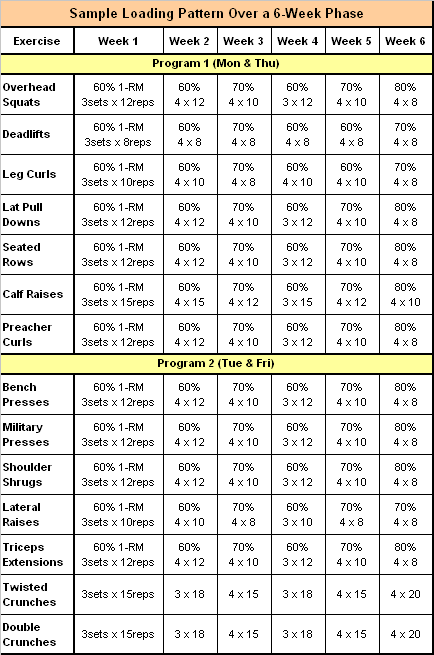
While this can get very complicated, once again you are encouraged to keep it simple. The major differences between the programs you will design for each “season” are as follows: Off- season: The off- season is the best time to make strength gains because fewer physical demands are placed on the body at this time. Overall training volume will generally be increased during the off- season. This means that more days per week may be used, more sets of each exercise and more energy overall will be spent on strength than any other time of the year. In general young athletes will train 2- 4 days per week and use 1. In general, strength training will consist of 2- 3 days per week and 1. The intensity of each set may be increased as the volume of work is decreased.
In- season: It is absolutely imperative that strength training be continued through the competitive season. The total volume of work will be reduced, so the relative intensity can be increased. The workouts will be less frequent and shorter in duration. Athletes should strength train at least one day per week, and no more than three days. Workouts will take 2. The number of training days per week and volume of each workout will depend upon the competitive schedule and physical demands of the sport. Decide what time of year it is, think about the facilities available, and consider which exercises you feel are most appropriate for you to teach and for your young athletes to perform.
Quads & Hips: Pick 1- 4 Exercises. Squat Deadlift Leg Press. Lunges DB/Trap Bar Deadlift 3- D Lunges. Leg Extension Glute/Ham Raise Step Ups. Machine Squat Airball Squat Hip Flexion. Hip Extension Hip Abduction Hip Adduction.
Volleyball Conditioning. Although most coaches are mainly focused on player skills when coaching. They also are able to hit the ball in the right direction at the right height and speed. They often have the ability to place the ball where they want to in their opponent. The most athletic setter's often make it. The best libero's react and move proficiently in the correct direction to make plays on the ball.
Both. static flexibility and. An. athlete with flexibility generates acceleration over a greater range of. The method of training must equal the physical demands specific to volleyball. How should you be training your muscles. Manipulating how the muscular system and nervous system. Traditional methods involve various. Skill based conditioning.
Volleyball conditioning should involve anaerobic. Would you like to create. Use the. following conditioning drills to improve speed, quickness, vertical. Plyometrics. is an important method for increasing volleyball players quickness and. Conditioning for volleyball involves training.
Testing before and throughtout a training cycle allows.. Dynamic flexibility is. Static Flexibility Exercises for Volleyball. Static stretching after a volleyball workout may be the best time. The increased muscle temperature.
Nutrition Guidelines. Volleyball nutrition and why nutrition is important for strength and power athletes.
Nutrition for volleyball players and how to eat preparing for tournaments and training.. Nutrition for Tournaments. Volleyball tournament nutrition tips, drinking plenty of water, consuming carbohydrates, electrolytes (mainly sodium and potassium) to prevent cramping and help muscle contraction Foods for Athletes. Do you know what foods to eat for volleyball? Pre Workout Foods. Pre workout nutrition is important because you need energy to train hard, build muscle, get stronger, and recover fast from hard workouts.
Not eating before and after your training is the dumbest thing.. Volleyball Summer Conditioning. Need tips to prepare for your school tryouts? Strategies for off- season training, speed, vertical jump, strength..


/https%3A%2F%2Fassets.over-blog.com%2Ft%2Fcedistic%2Fcamera.png)
/image%2F0000001%2F20170901%2Fob_d2ee77_10.jpg)